BBNJ and the Contest for Its Permanent Headquarters
A global report on the UN High Seas Treaty and the geopolitical implications of where its Secretariat is housed.
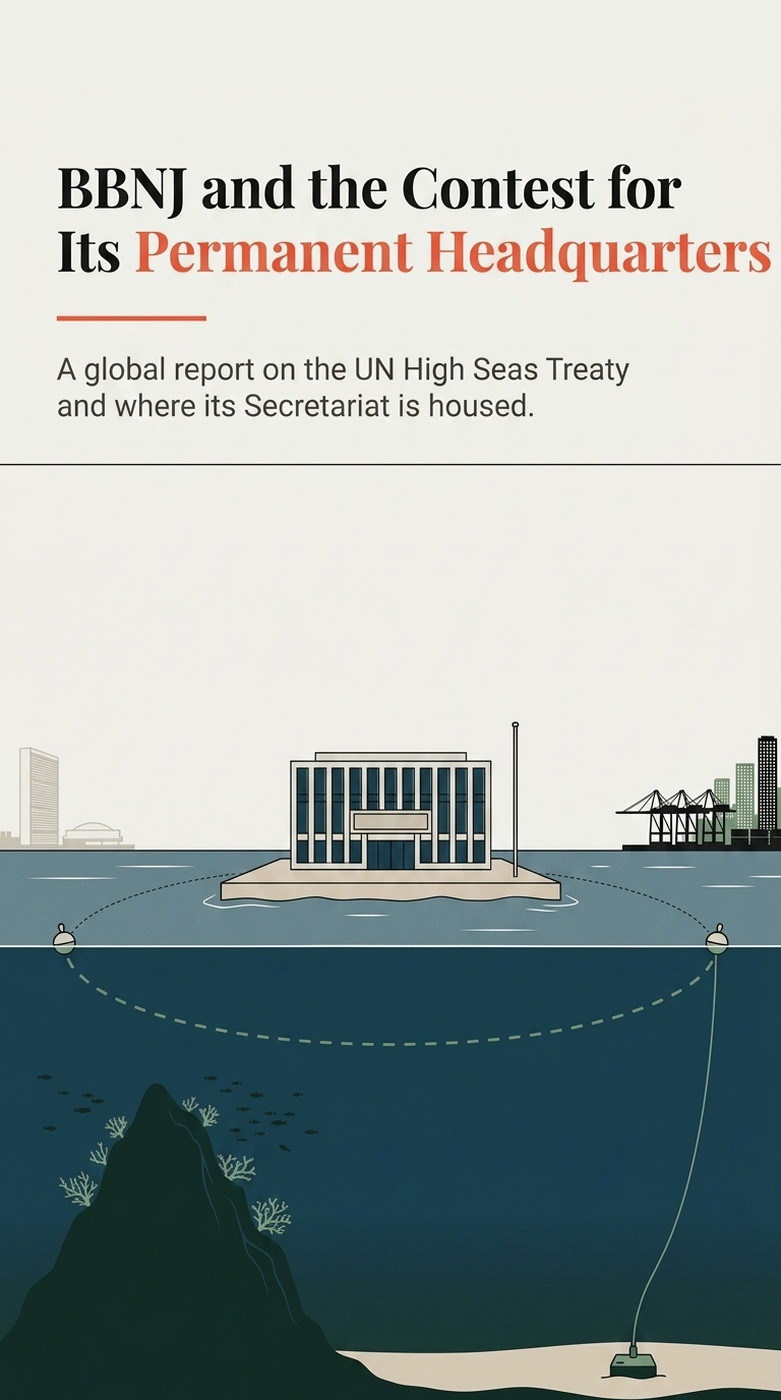
The BBNJ Agreement short for Biodiversity Beyond National Jurisdiction is formally titled the Agreement under the United Nations Convention on the Law of the Sea on the Conservation and Sustainable Use of Marine Biological Diversity of Areas beyond National Jurisdiction. It is commonly known as the High Seas Treaty.
The treaty concerns marine areas beyond the jurisdiction of any individual country. These include the high seas, meaning the water column beyond national maritime zones, and the international seabed, known legally as “the Area.” It does not alter maritime boundaries or give any country sovereignty over the high seas or international seabed.
The treaty was adopted by consensus at the United Nations on 19 June 2023, after nearly two decades of negotiations. It opened for signature on 20 September 2023 and entered into force on 17 January 2026, 120 days after the 60th ratification was deposited. Morocco provided the decisive 60th ratification on 19 September 2025.
The BBNJ Agreement is important because most ocean governance before it was fragmented. Fisheries, shipping, seabed minerals, marine pollution and scientific research were dealt with through different treaties and organizations. The Convention on Biological Diversity also had limited direct reach over biodiversity in areas beyond national jurisdiction.
BBNJ attempts to fill this gap through four principal areas.
First, it establishes rules on marine genetic resources. Marine organisms may contain genetic material useful for pharmaceuticals, biotechnology, agriculture, industrial enzymes and other applications. The treaty seeks to ensure that the benefits of research and commercial use are not captured exclusively by technologically advanced countries. It includes provisions relating to scientific data, samples, digital sequence information, capacity-building and benefit-sharing.
Second, it provides a framework for area-based management tools, including marine protected areas. These may protect ecologically important seamounts, coral ecosystems, migration routes, breeding grounds, deep-sea habitats and other biodiversity hotspots. An MPA can restrict activities such as fishing, bottom trawling, seabed exploration or other forms of extraction.
Third, the treaty establishes rules for environmental impact assessments, or EIAs. Planned activities under the jurisdiction or control of a party may need to be assessed if they could cause significant harm to the marine environment. An EIA can examine direct, indirect and cumulative impacts, alternatives, pollution, underwater noise, habitat destruction and effects on migratory species.
Fourth, BBNJ creates mechanisms for capacity-building and the transfer of marine technology. Developing countries, small island states and other vulnerable countries often lack the vessels, laboratories, satellite systems, autonomous vehicles and genetic-sequencing capacity required to study the high seas. The treaty aims to improve their access to training, equipment, research partnerships and scientific data.
How BBNJ differs from earlier agreements
BBNJ is the third implementing agreement under UNCLOS, but it does not replace UNCLOS or other ocean treaties.
The first is the 1994 Part XI Agreement, which governs the international seabed regime, especially mineral resources and seabed-mining activities. It provides the operating framework for the International Seabed Authority.
The second is the 1995 UN Fish Stocks Agreement, which deals with straddling fish stocks and highly migratory fish stocks. It strengthens cooperation between states and regional fisheries management organizations.
BBNJ is different because its central focus is marine biodiversity conservation and sustainable use across sectors. It covers marine genetic resources, protected areas, environmental assessments, scientific cooperation and technology transfer. It is not a global fisheries treaty, a seabed-mining treaty or a replacement for the International Maritime Organization or the International Seabed Authority.
The treaty also does not automatically ban fishing, mining or shipping on the high seas. Nor does it create a global ocean police force. Its effectiveness will depend on implementation by national governments and cooperation with existing sectoral organizations.
Membership and present office
The treaty's legal participants are called Parties, rather than “member states.” The latest available reporting from the 2026 Preparatory Commission placed the number at 88 Parties. The UN Treaty Collection has also listed 145 signatories. A signature indicates political support, but ratification or accession makes the treaty legally binding for that participant.
The United States signed the Agreement but had not ratified it according to reporting at the time of entry into force. Russia has been among the major states that had neither adopted nor ratified the Agreement, expressing concerns about existing governance arrangements and freedom of navigation.
There is currently no permanent BBNJ headquarters. The treaty's interim Secretariat is being performed by the UN Secretary-General through the Division for Ocean Affairs and the Law of the Sea, or DOALOS, within the UN Office of Legal Affairs.
China's bid and the possible risks
China's proposal to host the BBNJ Secretariat in Xiamen is more than a bid for an office location. It reflects China's expanding interest in global ocean governance, marine science and international rule-making.
China is a major maritime power with extensive research, port and oceanographic infrastructure. Hosting the Secretariat could bring greater Asian and developing-country participation into the BBNJ system. It could also allow China to present itself as a supporter of multilateral environmental governance and a provider of marine technology.
However, the bid has generated concerns because the Secretariat would manage important administrative and information functions. It would support COP meetings, coordinate scientific bodies, administer the Clearing-House Mechanism and assist with marine genetic-resource notifications, EIAs and MPA proposals.
The first risk is institutional independence. A Secretariat located in China would formally be an international body, not a Chinese agency. Nevertheless, other parties may worry about informal pressure over staffing, meeting access, scientific priorities or the presentation of politically sensitive issues. The Secretariat cannot itself create MPAs or rewrite treaty rules, but its control over documentation, meeting preparation and information flows could create agenda-setting influence.
The second risk concerns data security. BBNJ will involve information about marine genetic resources, genetic sequences, deep-sea habitats, scientific surveys, environmental assessments and oceanographic monitoring. Countries may question whether sensitive data stored in China could be accessed by Chinese state agencies or exposed to national-security requirements. China has argued that the host state should provide secure infrastructure for the Clearing-House Mechanism, but other states may insist that data governance remain internationally controlled and independently audited.
A third concern is access and participation. Researchers, NGOs, journalists and delegates from countries with difficult relations with China could face visa, accreditation or travel problems. Taiwanese institutions and civil-society groups critical of Chinese policy could be especially sensitive cases. Since BBNJ depends on broad participation by scientists, Indigenous Peoples, local communities and non-governmental organizations, restrictions could undermine the treaty's legitimacy.
A fourth issue is credibility under UNCLOS. China's bid will be assessed against its disputes with the Philippines and other countries over maritime claims and conduct in the South China Sea. Critics argue that a state accused by others of selective compliance with maritime law could face difficulty hosting an institution designed to strengthen the rules-based ocean order. Supporters counter that hosting an international treaty does not require agreement on every maritime dispute and that China's presence could make the system more representative of Asia and the Global South.
These risks are not inevitable. If China is selected, parties could demand strong safeguards: an independent Secretary, internationally recruited staff, transparent budgets, international cybersecurity audits, protected archives, guaranteed access for delegates and civil society, and a host-country agreement ensuring that the Secretariat reports to the COP rather than to Beijing.
The central question is therefore not whether China would automatically control BBNJ. It would not. The question is whether the treaty can maintain a clear separation between China as the host state and the BBNJ Secretariat as an independent international institution.
A Chinese headquarters could broaden the treaty's Asian and developing-country representation. Without credible safeguards, however, it could also weaken trust in the neutrality of the institution at the very moment when BBNJ is beginning to shape the future governance of the high seas.