The Environmental Cost of China's Geopolitical Footprint in the Philippines
A report on marine degradation, reef destruction, illegal mining, and the environmental threat in the West Philippine Sea.
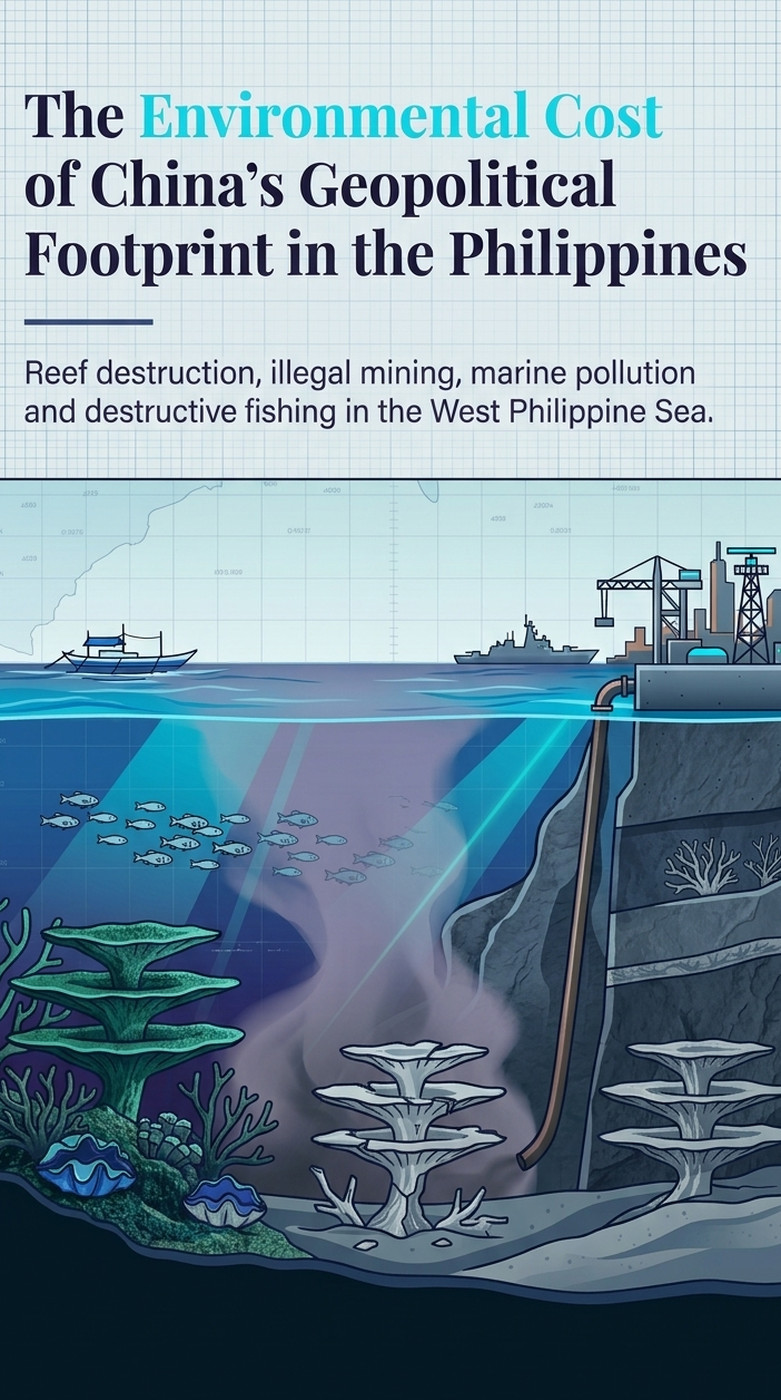
Chinese activities around the Philippines are no longer just a geopolitical concern; they are an environmental threat as well. The West Philippine Sea (WPS) or the South China Sea, a biologically diverse ecosystem, has become a site where continuous activities causing environmental degradation linked to China or Chinese backed operations is taking place. Even though China throughout claims its presence as a peaceful development, many a time claiming to be research-oriented, on-the-ground investigations and satellite images tell a different story. Several of Beijing's activities in the area can be associated with ecological harm, including reef destruction, illegal mining, marine pollution, and destructive fishing. China's actions are not only moving against shared responsibility but also undermines the Philippines security and long term sustainability.
Damage to the Coral Reef
China's visible environmental impact in the WPS stems from its large-scale island building and land reclamation program. According to the US-China economic and security commission, China between 2013 and 2015 itself had already constructed around 3000 acres of artificial islands on seven coral reefs it occupied in the Spratly islands involving itself in dredgering and depositing on top of the reefs.1 These activities buried vast stretches of live coral under tons of sediments and sand. The Asia Maritime Transparency Initiative puts a number to it and states that China, as of 2025, is responsible for the destruction of 6224 acres of reef.2
This figure could also be higher if the Philippine Coast Guard's May 2024 allegations that China had undertaken reclamation activity at Sabuna Shoal, evidenced by piles of dead and crushed coral observed on the seabed, are further substantiated.
These activities have heavy ecological consequences. Dredging is known to create massive sediment plumes that can extend kilometers, killing corals and blocking sunlight essential for photosynthesis in algae. It has been estimated that coral reefs could take as long as 10 to 15 years to recover, in case they recover at all. These concerns can be seen rising by unfortunate incidents such as that of June 2025 when a Chinese fishing militia vessel anchored near Thitu Island damaged 464 square meters of coral reefs.
Beijing's activities should be seen in relation to the 2016 UNCLOS Arbitral Tribunal award that found China guilty of causing damage to the marine environment through its land reclamation and artificial island building, violating Articles 192 and 194, amongst others, of the UNCLOS that focus on protecting and preventing the maritime environment and the ecosystem. Despite this ruling, such activities have been continued by China, further dismissing the tribunal's award as null and void.
Damage caused by illegal mining
Besides attempts to build islands, China-linked operations have continuously been engaged in illegal mining and seabed resource extraction in the Philippines. As these activities are unlawful, they are performed without any environmental impact assessments (EIAs), making it difficult to determine their ecological sustainability and assess the extent of environmental harm it can cause to the area. The unlawful mining practices in the seabed are also in direct contravention of UNCLOS Article 206 that mandates states to assess potential activities that may cause pollution and harmful changes to the marine environment.
The extraction for construction material alters seabed morphology, destroys endemic organisms, and triggers sedimentation that may further suffocate coral reefs. After the April 2021 executive order to lift the ban on mining agreements, Philippine scientific groups raised alarms over the destruction of seabed projects threatening the seagrass beds and soft-bottom ecosystem.3
Even though some of the mining occurs within the Philippines' jurisdiction, there are several public cases of territorial illegal mining activities that involve Chinese nationals along with Philippine locals. For example, the recent arrest of 20 Chinese officials in April 2026 involved in illegal copper and gold mining activities in Davao.4 Another incident is that of the February 2026 incident where the Philippine National Bureau of Investigation arrested 10 Chinese and 16 Filipino individuals, also seizing copper ore, processing plants, and other equipment in Bukidnon.5 It is not only Chinese citizens but also Chinese conglomerates like Jiangxi Rare Earth & Metals Tungsten Group, Wei-Wei Group, and Nihao Mineral Resources Inc, have been alleged of illegal mining in the Philippines as early as 2013 to feed China's industry with rare earth metal at the cost of the Philippines.6
Illegal mining activities, whether on land or water, means a lack of assessment and processes that are undertaken without assessing its cumulative impact on food chains, water quality, or the release of toxic chemicals.
Destructive Fishing
Another such form of environmental concern for the Philippines are the destructive fishing practices. The Philippine authorities have consistently accused the China-based fishing vessels of using cyanide to kill fish. These activities also lead to poisoning species that were not targeted, bleaching of corals, and compromising the overall food chain. A recent example of Chinese practices that raised concerns over environmental damage and maritime security was in April 2026, when the Philippine authorities confirmed that laboratory tests detected cyanide in bottles seized from Chinese fishing boats in February and October 2025 operating near Ayungin Shoal (Second Thomas Shoal).7
The 2016 Arbitral Tribunal found that Chinese fishing vessels had harvested endangered species like that of the giant clams on a large scale and in a manner that was destructive to the coral reef ecosystem. In fact, a 2023 report by the Asia Maritime Transparency Initiative even put a number to the damage of coral reefs caused by Chinese fishers in the process of harvesting giant clams as 16353 acres.8
The tribunal further linked the China Marine Surveillance (CMS) vessels to not only accompanying, protecting and escorting but also organising and coordinating the Chinese fishing vessels, putting the responsibility of such actions of violations on the Chinese government itself.9
Philippine authorities at various levels have blamed Chinese ships for destroying coral reefs and causing irreversible damage to the coral reef and the ecosystem through indiscriminate fishing activities. Such activities can not only be considered as acts by rogue fishermen but practices that are even at international levels have been associated with practices enabled by Chinese state tolerance.
The Geopolitical Dimension & Environmental Disinformation
The environmental crisis in the West Philippines sea/ South China Sea can not be separated from the geopolitical context. Many of the sites where ecological damage is taking place fall within the argument of the Philippines Exclusive Economic Zone (EEZ) and China's nine-dash lines. This continues despite the 2016 award finding no legal basis for China's nine dash lines and stating Beijing's violation of the duty to protect the marine environment.
Beijing has not addressed the issue with compliance but instead with activities that are closely linked to environmental disinformation or deflecting tactics. One such example of it is the 2025 Chinese December broadcast, where, without naming any country, media blamed military drills for the coral reefs damage near the Scarborough Shoal further providing a report blaming illegal fishing activities for threatening the ecosystem around the shoal.1011 Another such move by China was its plan to establish a nature reserve in one of the most contested maritime feature the Scarborough Shoal. This could be seen as another tactic used as a part of environmental disinformation where an activity is labeled as green to meet their economic or any other potential gains.
Conclusion
The issue is not development or construction activities itself but the need to strike a balance with environmental protection. Illegal activities put stress on ecosystems already reeling from chemical contamination and physical destruction. Unlike legitimate projects that generally include protocols, these operations leave behind environmental liabilities while providing no local benefits or shared prosperity. While development is necessary, the absence of environmental impact assessments (EIAs) and mitigation measures makes such projects ecological liabilities.
Actions towards such activities need to be taken so that environmental harm is not disguised as development. Countries must view strategic projects also through an environmental lens rather than just focusing solely on their geopolitical benefits. This becomes important when the environmental cost of such projects is absorbed disproportionately by communities or countries. It is unfair for one party to bear the cost while the other takes the benefits of development.
References
- 1.https://www.uscc.gov/sites/default/files/Research/China's%20Island%20Building%20in%20the%20South%20China%20Sea_0.pdf
- 2.https://amti.csis.org/keeping-score-vietnams-spratly-island-overhaul-continues/
- 3.https://ph.oceana.org/press-releases/scientists-fisherfolk-civil-society-groups-raise-alarm-on-destructive-seabed-quarrying/
- 4.https://www.philstar.com/nation/2026/04/23/2523107/20-chinese-mining-gold-copper-davao-region-arrested
- 5.https://nbi.gov.ph/press_releases/2026/02122026/9508/
- 6.https://ntucphl.org/2013/08/traitors-abetting-chinese-poaching-of-phl-minerals/
- 7.https://www.abs-cbn.com/news/nation/2026/4/13/ph-authorities-confirm-cyanide-in-bottles-seized-from-chinese-boats-near-ayungin-shoal-1808
- 8.https://amti.csis.org/deep-blue-scars-environmental-threats-to-the-south-china-sea/
- 9.https://brill.com/display/book/edcoll/9789004344556/B9789004344556_010.xml
- 10.https://www.straitstimes.com/asia/se-asia/china-blames-military-drills-for-reef-damage-around-disputed-shoal
- 11.https://www.scmp.com/news/china/diplomacy/article/3276617/china-says-its-ships-didnt-damage-south-china-sea-reef-philippine-coastguard-did